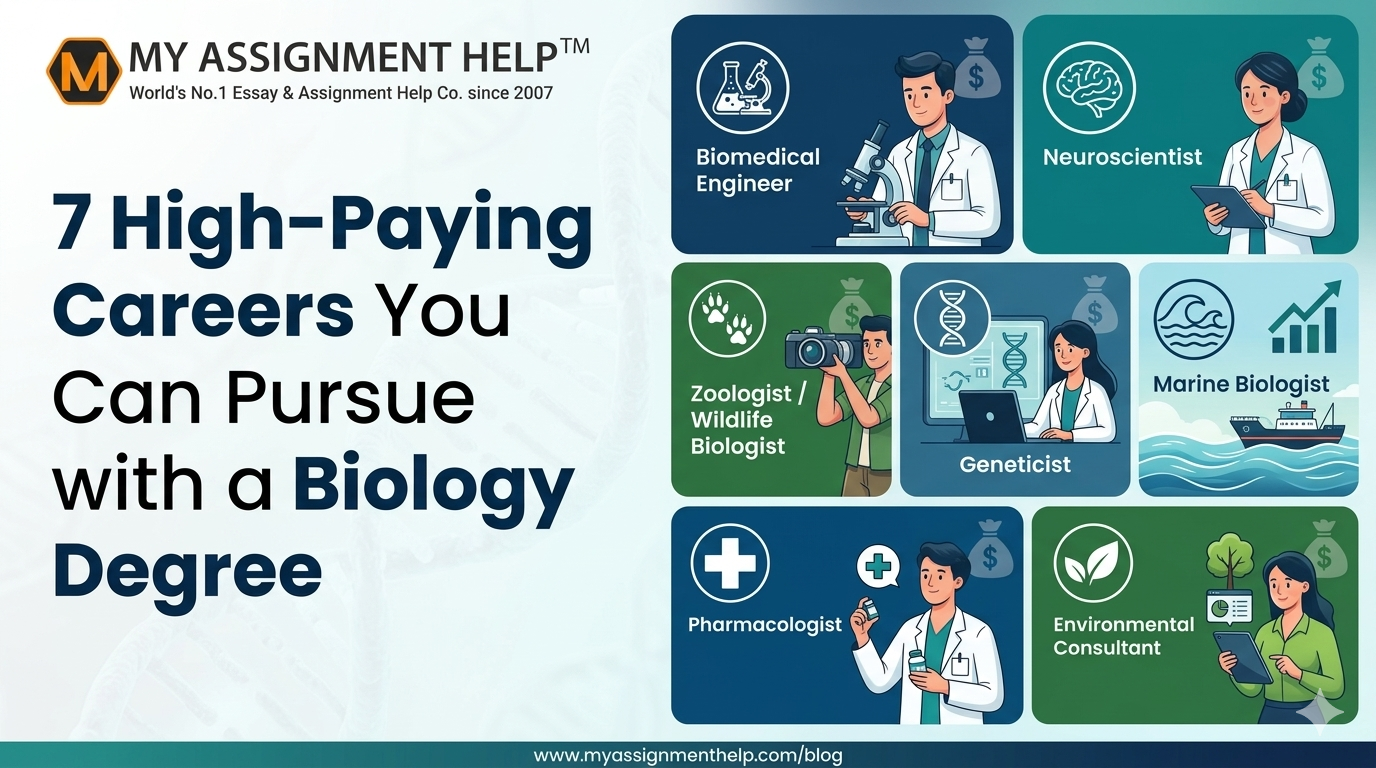
7 High-Paying Careers You Can Pursue with a Biology Degree: Moving Beyond Medical School
For decades, undergraduate biology majors in the United States have operated under a singular, rigid paradigm: graduate, pass the MCAT, and head straight to medical school. However, as the American biotechnology sector continues to undergo exponential expansion, this conventional pipeline no longer represents the sole pathway to financial security and professional prestige. Driven by breakthroughs in next-generation sequencing, CRISPR gene editing, computational biology, and corporate clinical frameworks, the lifecycle of biological data has shifted. The modern life sciences ecosystem demands professionals who can operate at the critical intersection of clinical science, deep technology, corporate strategy, and intellectual property law.
Navigating the rigorous academic prerequisites required to enter these elite corporate tiers can be an uphill battle. The sheer volume of empirical research, advanced laboratory write-ups, and statistical modeling parameters can quickly overwhelm even the most dedicated STEM scholars. When facing dense molecular cell biology data sets or exhausting biochemical paradigms, finding the capacity to balance your academic workload is paramount. It is during these critical points that utilizing highly targeted support systems, such as partnering with a trusted service like myassignmenthelp to strategically delegate assignments or asking expert academics to do my biology homework, allows ambitious undergraduates to preserve their elite GPAs while positioning themselves for high-paying corporate trajectories.
To maximize the return on investment (ROI) of a life sciences degree, students must target positions that capitalize on high industry demand and specialized technical skill sets. Below, we break down the seven highest-paying non-clinical careers available within the US biology landscape, backed by economic metrics from the US Bureau of Labor Statistics (BLS) and industry salary guides.
Key Takeaways
- Diverse Options: Medical school isn’t the only lucrative track; biotech, data science, corporate pharmacology, and law offer premium compensation packages.
- Top Earners: Bioinformatics Scientists and Medical Science Liaisons (MSLs) command standard starting salaries exceeding $100,000 in the US market.
- High-Growth Fields: Data-driven and cross-disciplinary roles—such as Biostatistics and Patent Law—show the highest projected job openings through 2033.
- Strategic Resource: Balancing rigorous STEM workloads requires structured support; planning ahead and leveraging professional toolsets ensures long-term career viability.
Logic to Landscape: The 2026 Life Sciences Career Matrix
An Analysis of Median Compensation, Core Technical Skills, and 10-Year Growth Trajectories in the United States.
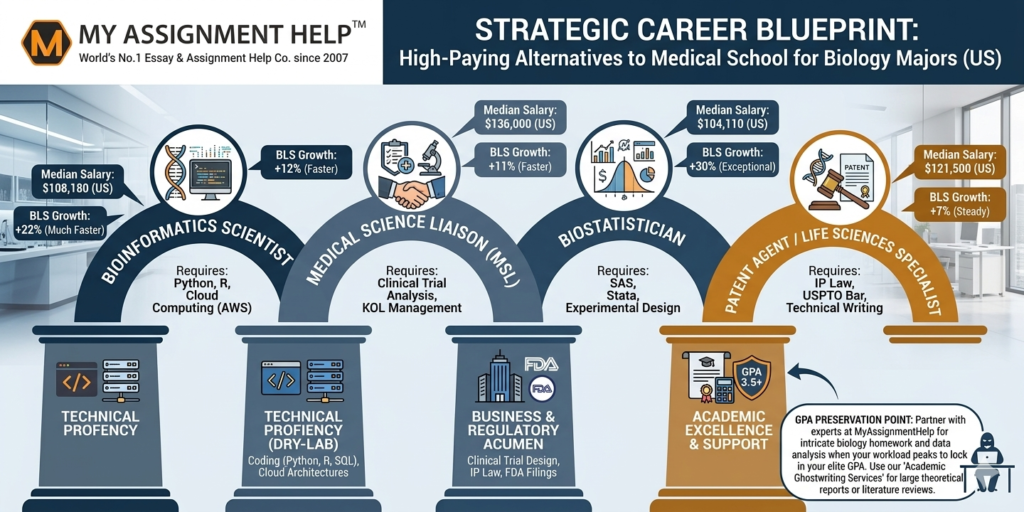
| Target Profession | Median US Salary | Required Toolset / Competency | BLS Growth Outlook |
| Bioinformatics Scientist | $108,180 | Python, R, Next-Gen Sequencing (NGS) | +22% (Much faster than average) |
| Medical Science Liaison (MSL) | $136,000 | Clinical Trial Analysis, KOL Management | +11% (Faster than average) |
| Biostatistician | $104,110 | SAS, Stata, Clinical Trial Design, Survival Analysis | +30% (Exceptional Growth) |
| Patent Agent / Specialist | $121,500 | USPTO Regulations, IP Law, Prior Art Search | +7% (Steady) |
| Biomedical Engineer | $100,730 | CAD Modeling, Biomaterials, FDA 510(k) Filing | +5% (Average) |
| Pharmacological Sales Consultant | $98,400 | B2B Value Proposition, Mechanism of Action (MoA) | +6% (Steady) |
| Corporate Sustainability Manager | $102,900 | ESG Reporting, Lifecycle Assessment (LCA) | +12% (Faster than average) |
1. Bioinformatics Scientist
As genomic sequencing technology has evolved from a multi-billion-dollar luxury to an accessible laboratory baseline, biology has transformed from a purely descriptive discipline into a data-driven science. Bioinformatics scientists sit directly at the convergence point of computer science, statistics, and molecular biology. They are responsible for developing complex algorithms, computational models, and analytical pipelines to parse through massive multi-omic data sets, identify pathogenic variants, and accelerate target discovery in oncology and rare disease domains.
To capture the premium compensation tiers associated with this role, candidates must demonstrate fluent proficiency in scripting languages like Python or R, along with cloud computing frameworks (AWS, Google Cloud) optimized for processing raw genomic data. The industry demands candidates who can bridge the communication gap between dry-lab quantitative modelers and wet-lab molecular biologists, making them indispensable components of major pharmaceutical innovation loops.
2. Medical Science Liaison (MSL)
Medical Science Liaisons operate as the elite technical experts within pharmaceutical, biotechnology, and medical device corporations. Unlike commercial sales personnel, MSLs are peer-level scientific educators who build strategic relationships with top-tier physicians, clinical investigators, and institutional healthcare leaders—collectively known as Key Opinion Leaders (KOLs). They translate complex clinical trial data, discuss off-label biological mechanisms, and convey real-world therapeutic feedback from clinical environments back to corporate R&D teams.
Because this position requires absolute scientific authority and exceptional communicative capability, companies heavily recruit advanced biology graduates who can critically digest clinical protocols. While many MSLs hold advanced terminal degrees (Ph.D., PharmD), a comprehensive background in cell biology and corporate trial structures serves as an optimal baseline for entry into this highly lucrative, travel-intensive consulting career.
3. Biostatistician
Every drug development process, clinical trial, and public health initiative in the United States lives or dies by empirical statistical validation. Biostatisticians apply mathematical and statistical methodologies to design clinical trials, calculate sample sizes, analyze patient outcomes, and evaluate the efficacy of experimental medical interventions. Their conclusions form the empirical basis for FDA approval frameworks, directly impacting hundreds of millions of dollars in corporate capital allocations.
This role is ideal for biology students who possess an affinity for mathematical rigor. By augmenting a foundational understanding of human biology with statistical programming packages such as SAS or Stata, graduates can secure positions within Contract Research Organizations (CROs), top-tier medical centers, and federal regulatory agencies like the CDC and FDA.
4. Patent Agent / Life Sciences Specialist
Intellectual property is the fundamental economic driver of the modern biotechnology industry. When a research laboratory discovers a novel therapeutic molecule, synthetic pathway, or diagnostic tool, they must secure patent protection to defend their market position. Patent Agents and Intellectual Property Specialists analyze complex scientific disclosures, perform extensive prior art searches, and draft detailed patent applications submitted to the United States Patent and Trademark Office (USPTO).
This career track offers an exceptional pathway to high-end compensation without requiring laboratory operations or patient contact. Biology graduates with strong technical writing and analytical reasoning skills are highly valued by corporate law firms and tech-transfer offices because they can read a raw laboratory notebook and synthesize it into ironclad legal claims. Many corporations will actively sponsor their specialists to clear the USPTO patent bar or pursue part-time law degrees.
5. Biomedical Engineer
Biomedical engineering bridges the gap between mechanical engineering principles, physical materials design, and living biological systems. These professionals design and optimize artificial organs, surgical instrumentation, advanced biocompatible prosthetics, and automated diagnostic machines. They are deeply involved in regulatory filings, ensuring that life-saving hardware satisfies stringent FDA safety parameters before deployment to clinical markets.
For biology graduates looking to pivot into this sector, focusing on tissue engineering, biomaterials, and three-dimensional computer-aided design (CAD) modeling is crucial. This industry is currently seeing immense growth due to the integration of wearable biomechanical telemetry devices and automated continuous glucose monitoring systems across the US healthcare system.
6. Pharmacological Corporate Sales Consultant
Biopharmaceutical sales consultants are responsible for introducing new pharmaceutical compounds and medical therapies to practicing physicians, hospital networks, and health insurance formularies. This is a highly technical sales position that requires a deep understanding of human physiology, biochemistry, and drug mechanisms of action (MoA).
Unlike standard consumer sales, a pharmaceutical consultant must be capable of presenting complex medical studies, explaining adverse event profiles, and engaging in sophisticated scientific debates with specialized physicians. For biology majors with an entrepreneurial drive, strong interpersonal skills, and a competitive edge, this career offers unparalleled earning potential driven by structured performance bonuses and uncapped commissions.
7. Corporate Sustainability & ESG Manager
As the regulatory landscape in the United States places increasing pressure on corporations to document and mitigate their environmental footprint, the demand for corporate sustainability experts has surged. Sustainability managers analyze corporate supply chains, compute carbon outputs, design ecological remediation programs, and draft comprehensive Environmental, Social, and Governance (ESG) compliance briefs for executive leadership teams.
A biology degree provides an unrivaled foundation for this role, equipping professionals to accurately assess biodiversity impacts, manage industrial waste biochemistry, and lead corporate water conservation initiatives. Operating within major logistics, manufacturing, or consumer goods corporations, these science-driven executives ensure that modern corporate operations align with federal EPA guidelines and evolving consumer preferences.
Maximizing Your Biology Degree: The Strategic Transition
Securing a high-paying position in these alternative fields requires a deliberate shift in undergraduate preparation. Modern recruiters prioritize professionals who proactively combine their core scientific competencies with business acumen, programming skills, or regulatory knowledge. Rather than spending every elective credit inside standard wet labs, ambitious students should actively diversify into biostatistics, corporate management, or data visualization frameworks.
Moreover, the rigorous writing requirements demanded by modern higher education—ranging from senior honors theses to comprehensive literature reviews—require a flawless technical execution. If you find your attention divided between mastering Python for bioinformatics and drafting extensive scientific histories, utilizing premier academic ghostwriting services can streamline your process. Delegating extensive theoretical drafts to expert ghostwriters helps you protect your GPA and focus entirely on building the quantitative, real-world portfolio skills that modern biotechnology corporations demand.
Frequently Asked Questions (FAQs)
Q1: Can I get a high-paying biology job with only a Bachelor’s degree (B.S.)?
A1: Yes. Positions like Pharmacological Sales Consultants, Patent Specialists, and Associate Bioinformatics Analysts frequently hire B.S. graduates, provided they have relevant corporate internships, programming certifications, or verified field experience.
Q2: Which coding languages are most valuable for a biology major in the US market?
A2: Python and R are the absolute industry standards for genomic analysis, algorithmic development, and complex data visualization. SQL is also highly beneficial for managing large clinical trial databases.
Q3: How important is my GPA when applying for corporate life science roles?
A3: While specialized internships and technical portfolios carry immense weight, maintaining a GPA above 3.5 is critical for clearing initial resume filters at top-tier pharmaceutical firms, major consulting agencies, and elite research labs.
Q4: What is the fastest-growing sector for biology graduates right now?
A4: The intersection of biology and data science—specifically Biostatistics and computational Bioinformatics—is experiencing unparalleled growth due to the immense quantities of data generated by advanced molecular therapies and personalized medicine models.
About the Author
Dr. Evelyn Vance | Senior Academic Consultant & Life Sciences Strategist
Dr. Evelyn Vance holds a Ph.D. in Molecular Biology from Johns Hopkins University and has over twelve years of experience advising corporate biotechnology teams and academic departments across the United States. Currently serving as a Senior Academic Consultant at MyAssignmentHelp, Dr. Vance specializes in structuring career transition strategies for undergraduate STEM students, designing data-driven academic curricula, and helping life science scholars navigate technical milestones with elite, compliant academic support systems.
Data Sources & References
- US Bureau of Labor Statistics (BLS). (2025). Occupational Outlook Handbook: Biochemists, Biophysicists, and Statisticians. Washington, D.C.: US Department of Labor.
- National Center for Biotechnology Information (NCBI). (2025). The Economic Impact of Genomic Sequencing Technologies on the Biotech Job Market. Bethesda, MD: National Institutes of Health.
- PhRMA Industry Research Report. (2026). The Evolution of Corporate Medical Science Liaisons within US Biopharma. Pharmaceutical Research and Manufacturers of America.
Related Article
Nuggets vs Timberwolves Match Player Stats & Rivalry Breakdown

Poker88: A Complete Guide to Online Poker Entertainment